


The 45th International Conference on Computer Safety, Reliability and Security
22-25 September 2026
Universitat Politècnica de València (UPV), Spain
The 45th edition of SafeComp, to be held in Valencia, Spain, provides a unique occasion to explore and debate the growing challenges of safety-critical computing systems. Safety is more relevant than ever, as adaptive and advanced digital infrastructures are increasingly embedded across all layers of hardware and software, giving rise to complex systems of systems. These computing systems must not only deliver high performance and scalability but also work in a sustainable way, addressing energy efficiency, resource usage, and long-term societal impact.
The 2026 theme is “Engineering safe and sustainable computing systems”. Safety engineering must therefore evolve to tackle this dual challenge: guaranteeing safety while ensuring sustainability in computing infrastructures.
Since it was established in 1979 by the European Workshop on Industrial Computer Systems, Technical Committee 7 on Reliability, Safety and Security (EWICS TC7), SafeComp has contributed to the progress of the state-of-the-art in dependable application of computers to safety-related and safety-critical Systems.
SafeComp is an annual international conference covering the state-of-the-art, industrial experiences and new trends in the areas of safety, security and reliability of critical computer applications.
SafeComp provides ample opportunity to exchange insights and experience on emerging methods, approaches and practical solutions. It is a single-track conference without parallel sessions, allowing easy networking.

Centre for Humanistic Ethics in Risk Management Scandinavia (CHERMS)
23rd-24th September 2026
Svendborg, Denmark
Moral Dilemmas
Improve your decision making under pressure
We are pleased to invite you to our first Convention on Humanistic Ethics in Risk Management in Svendborg, Denmark from 23-24th September. The theme of the convention is ‘Moral Dilemmas’.
An appeal for Humanistic Ethics
Nearly all risk methodologies and decision models are anchored to the STEM worldview (Science, Technology, Engineering and Mathematics). What matters is what gets measured because the key purpose is to control the risk. This single-minded quest for control makes people at the receiving end nervous (in fact, nervousness is now a valid root cause in maritime audits). Likewise, accident methods, in their search for certainty and control (root cause), are known to traumatise people even more than the experience of the accidents.
This Convention is a call for Humanistic Ethics. It is an appeal to leaders and regulators to think more holistically about risk and decision making at all levels. We achieve this by bringing transdisciplinary methods to STEM to achieve a balance between subjective decisions with objective rules, measurable outcomes with intangible motivations, and more importantly, by acknowledging that fallible humans work and
live in an imperfect world. It is an appeal for humility in a world that has become one-sided and quite frankly, obsessed with efficiency
and control. It is a humble beginning not knowing what lies ahead. At this stage, it is a tiny step forward in the right direction.
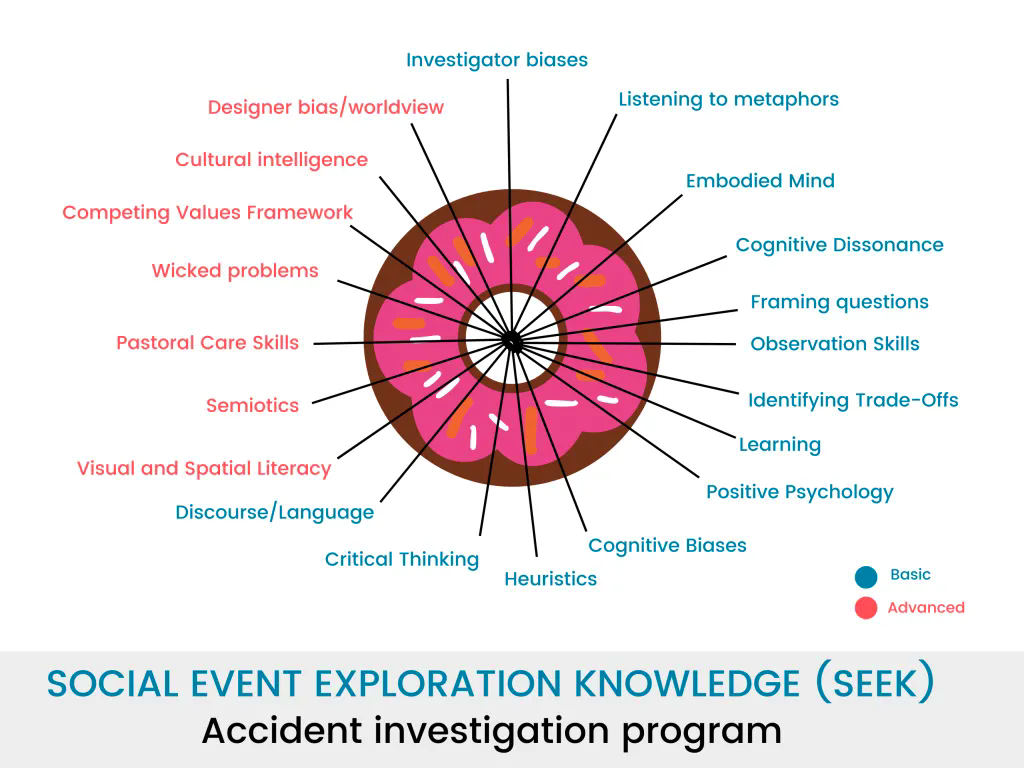
18th - 20th November 2026 - London Heathrow Marriott Hotel.
95% of our decisions are made in the unconscious mode.
Do you want to learn how human beings make decisions as individuals and in groups? Do you want to know how people behave under stress and pressure?
These two aspects of human behaviour are key to learning from accidents and events and getting better at managing the risk.
This is the focus of Social Psychology Event Exploration Programme (SEEK) based on Social Psychology of Risk.
No lectures, no presentations, and no arguments. The course is uniquely designed keeping in mind how we learn and shift our perspectives most effectively i.e. through experiential learning.