


- Details
- Written by: Administrator

This is the discussion area of the Safety Systems Community.
- Details
- Written by: Alex King
Survey Request
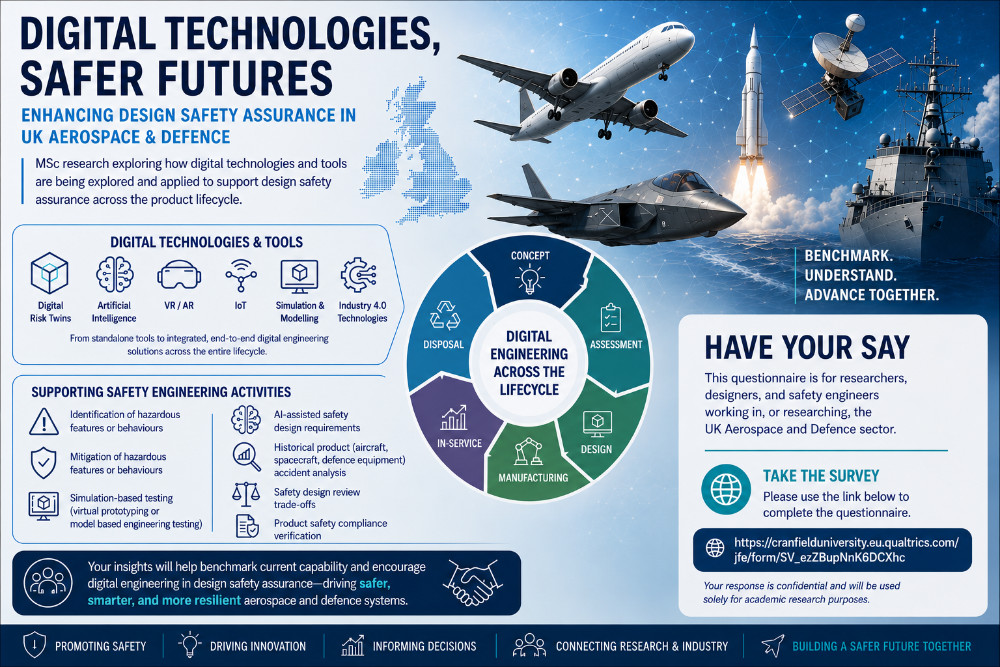
Digital Technologies for Design Safety Assurance in UK Aerospace and Defence
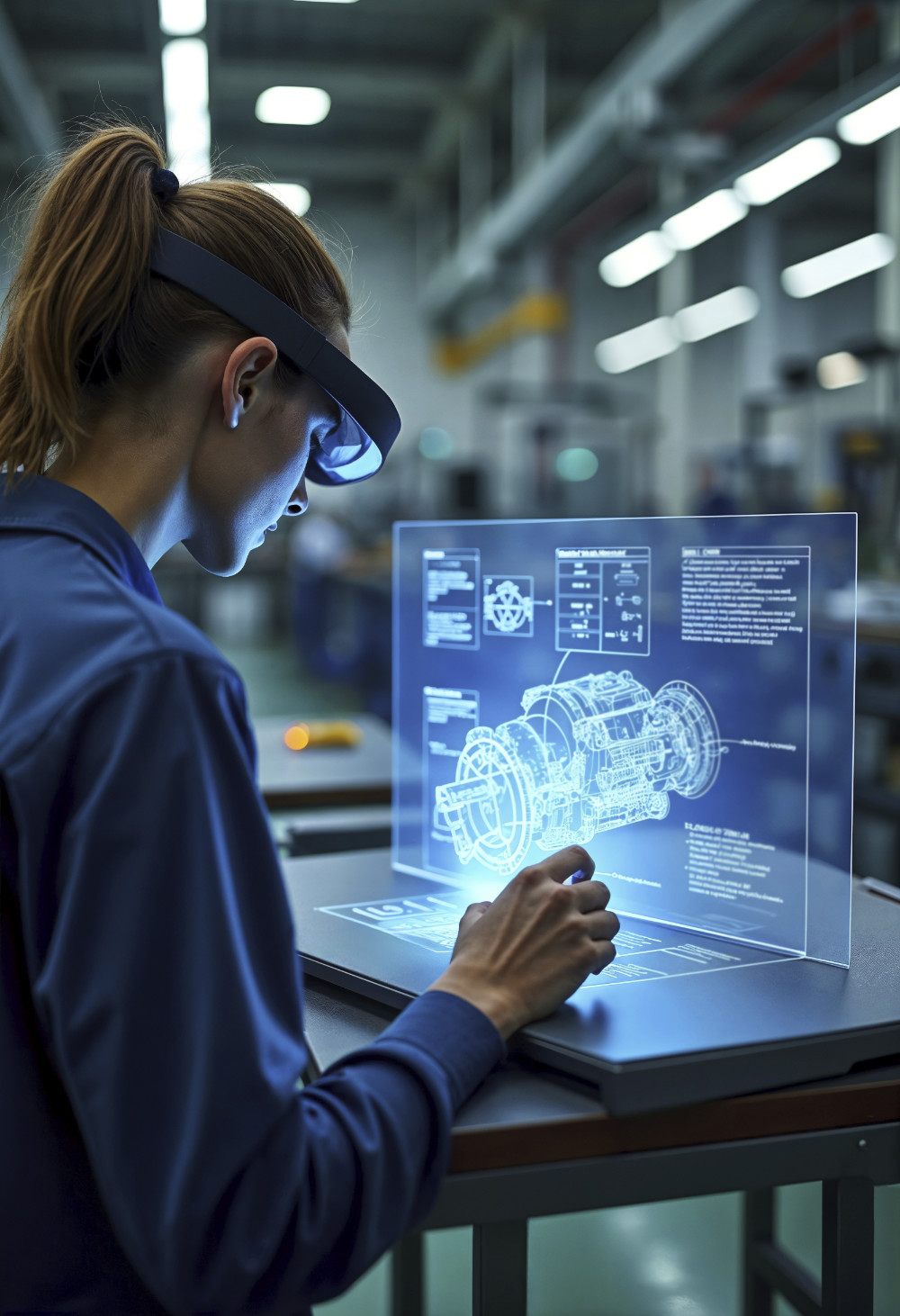 The increasing complexity of aerospace and defence systems demands robust, forward-looking approaches to safety assurance. As part of my MSc research, I am investigating how digital technologies and tools are being explored and applied within the UK aerospace and defence sectors to support design safety assurance across the product lifecycle.
This research focuses on both standalone technologies—such as Digital Twins, Artificial Intelligence (AI), Virtual and Augmented Reality (VR/AR), Internet of Things (IoT), and advanced Simulation and Modelling tools—as well as integrated, end-to-end digital engineering approaches spanning concept development through to disposal.
In particular, the study examines how these technologies are being used to support key safety engineering activities, including:
- Identification and mitigation of hazardous features or behaviours
- Simulation-based testing, including virtual prototyping and model-based engineering
- AI-assisted safety requirements development
- Historical accident and incident analysis
- Safety design trade-off analysis
- Product safety compliance verification
A central aim of this research is to understand the current level of implementation across industry and research organisations, as well as the drivers and barriers influencing adoption. The study also seeks to explore the extent to which ongoing research is effectively supporting practical application within industry.
To support this work, I am conducting a questionnaire aimed at researchers, designers, and safety engineers working in, or contributing to, the UK aerospace and defence domain.
Survey Link: https://cranfielduniversity.eu.qualtrics.com/jfe/form/SV_ezZBupNnK6DCXhc
Your insights will contribute to establishing a benchmark for digital engineering in design safety assurance and help identify opportunities to strengthen alignment between research and industry practice. Thank you in advance for your support.
Natasha Laycock
Cranfield University
- Details
Is there any specific term or common definition that can be used to describe the concept of 'Safety Critical'?
The closest I can achieve is to consider the compound of Safety Critical with additional terms such as 'Function', 'Task', 'Feature', etc. where the existence of such provides controls to protect against an immediate realisation of a hazardous state, and the failure of such would result in that hazardous state.
- Details
Originally posted by Neil Morley Jul 4th 2023.
_____________________
Dear Members,
The SCSC are invited to participate in an online survey that forms part of an MSc research project (Safety Critical Systems Engineering – University of York) titled;
‘Integrated Safety & Security Causality Modelling & Analysis: Current Challenges & Potential Solutions within the UK’s Critical National Infrastructure’
“If it’s not secure, it’s not safe”– this assertion is the foundational principle behind the research project.
In recent years, a paradigm shift has occurred within the safety engineering discipline as security has been recognised as a fundamental and integral component of safety; security has the potential to protect the safety attributes of a system and compromise the safety attributes of a system, both directly and indirectly.
The question of whether a system can be considered safe in the absence of security considerations is at the centre of this paradigm shift. Will a safety critical system perform the required safety functions to the required (or claimed) performance level where security has not been considered? Is the causal chain of hazards limited exclusively to accidental failures (e.g. random hardware, systematic and common cause failures)? Is the requirement to consider malicious acts or negligent actions unnecessary as they cannot cause hazards that have not already been identified or contribute towards those that have? Can this be substantiated in the absence of evidence? What processes and evidence artefacts are necessary to substantiate that the hazard analysis for the system is suitable and sufficient?
Integrated safety & security causality modelling and analysis is an approach to hazard analysis that takes into consideration both safety and security contributions to system safety.
The purpose of this survey is to gather the experiences and observations of four principal stakeholder perspectives relating to the subject of 'integrated safety and security causality modelling and analysis' within the UK’s Critical National Infrastructure (CNI).
The objective of the research project is to understand the current challenges experienced (primary data gathered through the survey) for the purposes of identifying potential [focussed] solutions for further development (this may include for example an extension/ adaption of a commonly used existing safety causality modelling and analysis technique to account for security considerations).
The survey consists of twenty logically presented questions that shall take you approximately 15 minutes to complete. Further information regarding the survey can be found within the Participant Information Sheet.
Your participation would be very much appreciated as it represents valuable real-world insight into a very significant and emerging field of safety engineering.
Please feel free to share the invitation to other relevant safety and/or security practitioners working within the UK’s Critical National Infrastructure for their valued participation.
Thank you for your participation and support.
Follow this link to the survey: Take Survey
Alternatively, copy and paste the URL below into your internet browser: https://york.qualtrics.com/jfe/form/SV_8w8ZhB6xvHrolcW
Kind regards,
Neil Morley
nm1244@york.ac.uk
- Details
Originally submitted by Dewi Daniels Jun 9th 2023.
________________
I thought members might be interested in the following online masterclass by Michael Wooldridge. He's professor of AI at the University of Oxford and AI director at the Alan Turing Institute.