Survey Request
Digital Technologies for Design Safety Assurance in UK Aerospace and Defence
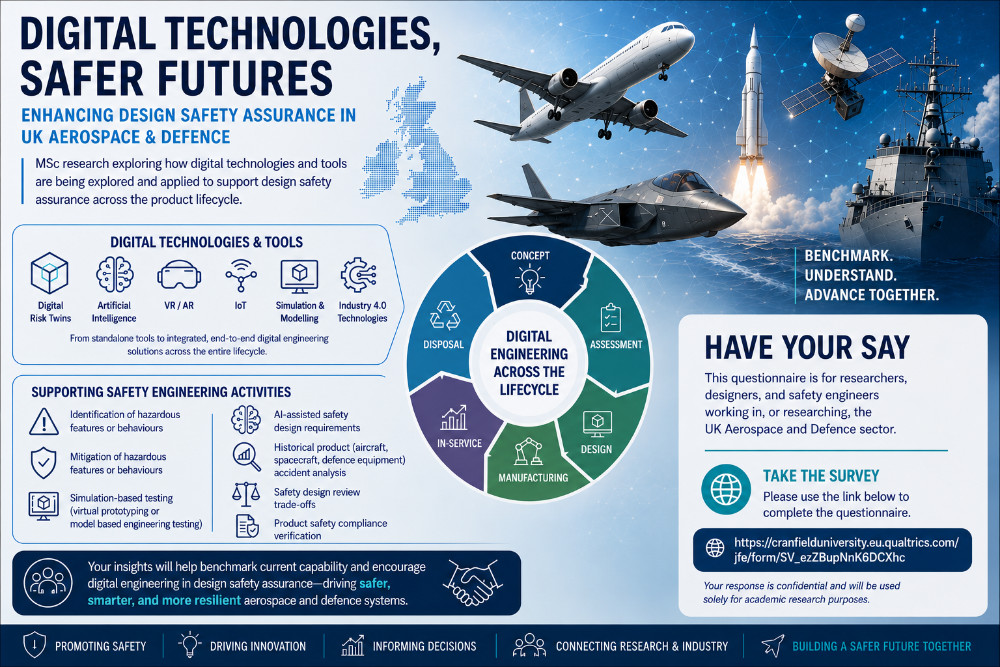
 The increasing complexity of aerospace and defence systems demands robust, forward-looking approaches to safety assurance. As part of my MSc research, I am investigating how digital technologies and tools are being explored and applied within the UK aerospace and defence sectors to support design safety assurance across the product lifecycle.
This research focuses on both standalone technologies—such as Digital Twins, Artificial Intelligence (AI), Virtual and Augmented Reality (VR/AR), Internet of Things (IoT), and advanced Simulation and Modelling tools—as well as integrated, end-to-end digital engineering approaches spanning concept development through to disposal.
In particular, the study examines how these technologies are being used to support key safety engineering activities, including:
- Identification and mitigation of hazardous features or behaviours
- Simulation-based testing, including virtual prototyping and model-based engineering
- AI-assisted safety requirements development
- Historical accident and incident analysis
- Safety design trade-off analysis
- Product safety compliance verification
A central aim of this research is to understand the current level of implementation across industry and research organisations, as well as the drivers and barriers influencing adoption. The study also seeks to explore the extent to which ongoing research is effectively supporting practical application within industry.
To support this work, I am conducting a questionnaire aimed at researchers, designers, and safety engineers working in, or contributing to, the UK aerospace and defence domain.
Survey Link: https://cranfielduniversity.eu.qualtrics.com/jfe/form/SV_ezZBupNnK6DCXhc
Your insights will contribute to establishing a benchmark for digital engineering in design safety assurance and help identify opportunities to strengthen alignment between research and industry practice. Thank you in advance for your support.
Natasha Laycock
Cranfield University