


 The Transportation Safety Board (TSB) of Canada has completed its investigation of the 2023 Titan Implosion and published a report on 17th June 2026.
On 18 June 2023, the submersible Titan, with 5 people on board, was descending to the wreck of the Royal Mail Ship Titanic, located 372 nautical miles south-southeast of Cape Race, Newfoundland and Labrador. The Titan was owned by the U.S. based company OceanGate.
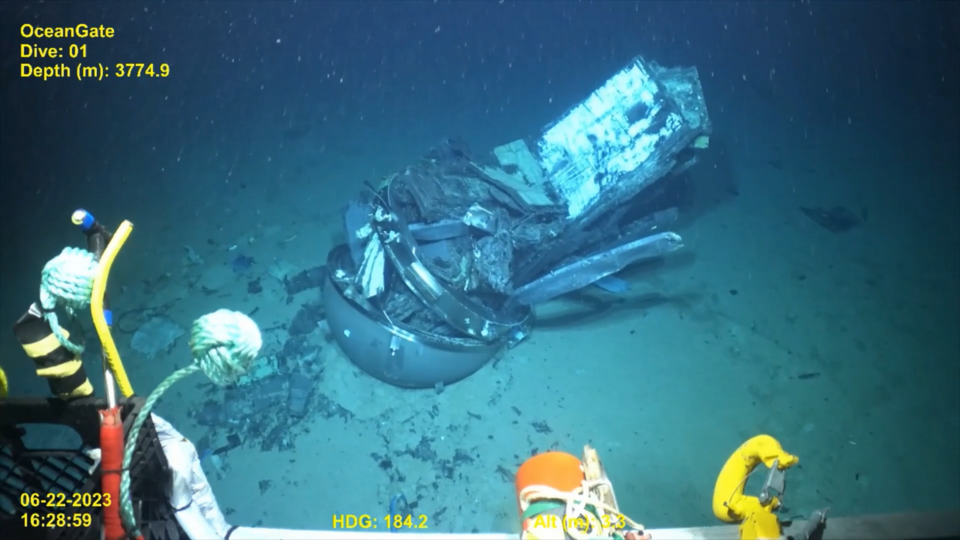
The Titan was being supported by a Canadian cargo vessel, the Polar Prince, which was being used to tow the Titan to and from dive locations, as well as providing a base for OceanGate’s operations. During the Titan’s descent, an OceanGate surface support team aboard the Polar Prince was tracking the Titan and maintaining communication. Approximately 1 hour and 45 minutes after the Titan began its descent, the surface support team lost all contact with it. A search and rescue operation was initiated later that evening. On 22 June, the U.S. Coast Guard confirmed that the wreckage of the Titan had been found on the ocean floor near the Titanic. There were no survivors.
The Titan’s pressure hull consisted of a carbon fibre cylinder that was capped at either end by titanium domes. The use of carbon fibre in a pressure hull for a human-occupied submersible intended for deep-ocean diving is novel; submersibles used for deep-ocean diving are typically constructed of steel or titanium. As well, the pressure hull is typically spherical, not cylindrical, because this is the best shape for resisting external pressure and allowing even distribution of stresses.
The investigation determined that the as-built properties of the Titan’s carbon fibre cylinder were never validated to ensure they met the theoretical values used in the design process and that the construction and testing of the Titan did not follow standard engineering practices. As a result, OceanGate did not know for how long the Titan’s pressure hull would remain structurally intact when used repeatedly for dives to the depth of the Titanic.
In an attempt to mitigate this problem, OceanGate had developed two systems to monitor the integrity of the pressure hull: a strain monitoring system and an acoustic monitoring system. The strain monitoring system provided data for post-dive analysis to identify potential problems with the pressure hull that could lead to failure on a subsequent dive. However, analysis of the strain data by OceanGate was inconsistent and did not result in the pressure hull being removed from service before its failure. The acoustic emission monitoring system was being relied on to provide enough advance warning for the submersible to surface in the event of an impending hull failure. However, this system had not been tested to demonstrate that it would consistently provide enough advance warning, and it did not function as intended during the occurrence.
Analysis by the TSB Laboratory determined that the reduced compressive strength of the Titan’s carbon fibre cylinder, as well as defects that were potentially introduced during manufacturing, operations, storage, and transport of the Titan, likely led the cylinder to fail progressively, due to damage accumulating during each dive cycle, until it imploded.
The investigation found that risk management at OceanGate was hindered by the structure and composition of the company as well as by the influence of power dynamics and social and psychological factors. As a result, OceanGate did not identify and mitigate key risks associated with the structural integrity of the Titan. Also, the investigation looked at issues relating to oversight of submersible operations, emergency response preparedness for submersibles, and safety management as it relates to groups working on a vessel.
The investigation identified safety deficiencies related to oversight and standards that led the Board to issue 6 recommendations.
https://www.tsb.gc.ca/eng/enquetes-investigations/marine/2023/m23a0169/m23a0169.html
img: Public Domain